The Role of VCF 9 in Modern Private Cloud Architecture
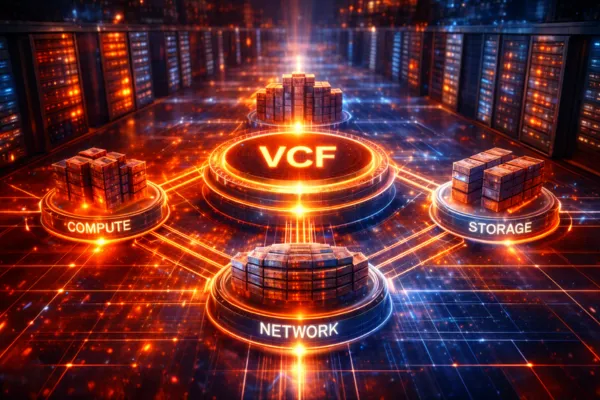
Modern private cloud environments require more than virtualized infrastructure. They demand integrated platforms that unify compute, storage, networking, security, and lifecycle management. VMware Cloud Foundation addresses this requirement by delivering a consistent, automated, and scalable private cloud architecture. For IT leaders, VCF 9 represents a shift toward platform driven operations that reduce complexity while improving control, performance, and security across hybrid environments.
Private Cloud Architecture Has Become Fragmented
Many private cloud environments have evolved incrementally.
Organizations adopted virtualization, then added storage abstraction, then introduced software defined networking, often across different tools and platforms. While each step delivered value, the result is frequently a fragmented architecture.
Common characteristics of these environments include:
Multiple management interfaces
Disconnected lifecycle processes
Inconsistent security policies
Limited visibility across workloads
Operational silos between teams
This fragmentation introduces complexity that slows down operations and increases risk.
Modern private cloud architecture requires consolidation and standardization at the platform level.
What Defines a Modern Private Cloud Platform
A modern private cloud is not defined by individual technologies. It is defined by how those technologies operate together.
Key requirements include:
Integrated compute, storage, and networking
Centralized lifecycle management
Consistent security across all workloads
Automation driven provisioning and operations
Support for hybrid and multi cloud environments
Without these capabilities, private cloud environments struggle to deliver predictable performance and scalability.
This is where VMware Cloud Foundation becomes relevant.
Understanding VMware Cloud Foundation
VMware Cloud Foundation is an integrated software stack designed to deliver a complete private cloud platform.
It combines:
vSphere for compute virtualization
vSAN for software defined storage
NSX for networking and security
SDDC Manager for lifecycle management
These components are tightly integrated and tested together, allowing organizations to deploy a standardized cloud environment from the start.
This approach reduces the need for custom integration and minimizes operational complexity.
Why Integration Matters More Than Ever
In traditional environments, each infrastructure layer is managed independently.
This leads to:
Delayed updates and patching cycles
Compatibility issues between components
Increased operational overhead
Greater risk of configuration drift
VCF addresses this by providing a unified lifecycle management framework.
With SDDC Manager, updates across compute, storage, and networking can be orchestrated in a coordinated manner.
This ensures:
Consistency across the environment
Reduced downtime during upgrades
Improved stability and performance
Integration is not just a convenience. It is essential for maintaining operational integrity at scale.
Security as a Native Capability
Security must be embedded into the platform, not added as an afterthought.
VCF integrates security through NSX, enabling:
Micro segmentation of workloads
Distributed firewalling
Identity aware security policies
Consistent enforcement across environments
This approach aligns with modern zero trust principles, where trust is not assumed based on network location.
Instead, policies are applied at the workload level, reducing the risk of lateral movement within the environment.
For organizations operating in regulated industries, this level of control is critical.
Automation and Lifecycle Management
One of the defining characteristics of VCF is its approach to automation.
Manual processes introduce inconsistency and limit scalability.
VCF enables automation across:
Infrastructure deployment
Workload provisioning
Policy enforcement
Lifecycle management
SDDC Manager plays a central role by orchestrating these processes through a single interface.
This reduces the burden on IT teams and ensures that environments remain aligned with defined standards.
Automation also accelerates time to value, allowing organizations to deploy and scale environments more efficiently.
Supporting Hybrid Cloud Consistency
Most organizations operate across both private and public cloud environments.
Consistency between these environments is essential for:
Workload portability
Unified security policies
Simplified operations
Cost control
VMware Cloud Foundation provides a consistent architecture that can extend into public cloud environments through VMware Cloud offerings.
This enables organizations to:
Move workloads between environments without rearchitecting
Maintain consistent operational processes
Apply the same security and governance policies across all platforms
Hybrid cloud is not just about connectivity. It is about consistency.
Reducing Operational Complexity
Operational complexity is one of the biggest barriers to effective cloud adoption.
Fragmented tools and manual processes increase the likelihood of errors and inefficiencies.
VCF reduces complexity by:
Consolidating infrastructure components into a single platform
Providing centralized management and visibility
Automating routine tasks
Standardizing deployment and configuration processes
This allows IT teams to focus on strategic initiatives rather than day to day maintenance.
Performance and Scalability Considerations
Modern applications require environments that can scale dynamically and deliver consistent performance.
VCF supports this through:
Distributed resource management
High availability features
Automated workload balancing
Scalable storage and networking capabilities
By integrating these capabilities into a single platform, VCF ensures that performance and scalability are built into the architecture.
This is particularly important for organizations supporting data intensive or latency sensitive applications.
What This Means for IT Decision Makers
For CIOs, CTOs, and infrastructure leaders, the adoption of VCF is not just a technology decision.
It is a strategic move toward:
Standardized cloud operations
Improved governance and control
Reduced risk and complexity
Faster delivery of IT services
However, successful implementation requires more than deploying the platform.
Organizations must align their operating models, processes, and teams to fully leverage its capabilities.
This includes:
Defining clear governance frameworks
Establishing automation strategies
Integrating security into all layers of the environment
Continuously optimizing performance and cost
Conclusion
The role of VMware Cloud Foundation in modern private cloud architecture is clear.
It provides a unified platform that simplifies operations, enhances security, and enables scalable, consistent environments across hybrid cloud landscapes.
As private cloud strategies evolve, platforms like VCF become essential for delivering the control and predictability that organizations require.
Infrastructure alone is no longer enough. Integrated platforms that combine automation, security, and lifecycle management are now the standard.
To explore how these principles can be applied in your environment and access practical frameworks for implementation, visit:
https://strategix-cloud.ca/resource-center